
mental health
Why does loneliness get worse at night?

Most people seek emotional support around 9pm, not 3am. But the conversations that happen between 1 and 5am run about 20% longer than the evening peak. Here's what the data says, and two theories for why.
Support requests peak at 9pm, not 3am. But the smaller group still awake between 1 and 5am talks longer than anyone else.
Key finding: Requests for emotional support peak at 9pm and fall off fast after midnight. The conversations that do happen between 1am and 5am, though, run about 14% longer than daytime ones, and 4am is the single longest hour of the day to talk.
The idea that loneliness peaks at 3am is everywhere: the "it's always darkest" cliché, the song lyrics, every joke about doomscrolling at 2am. It's specific enough that people rarely check it against anything. I looked at when people actually reach out for emotional support, timed to the hour, across more than a million messages. Part of the 3am story holds up. Part of it doesn't.
The real peak is earlier than people guess
Ask someone when others are most likely to reach out for emotional support, and "late at night" is a common answer. It's not wrong, just early. Conversations cluster between 8 and 10pm, and the single busiest hour is 9pm US Eastern, with 940 separate conversations starting in that hour alone. That's still evening: dinner is over, kids are down, and the day has emptied out enough for whatever got postponed to surface.
The quietest hour for starting a new conversation is 6am.
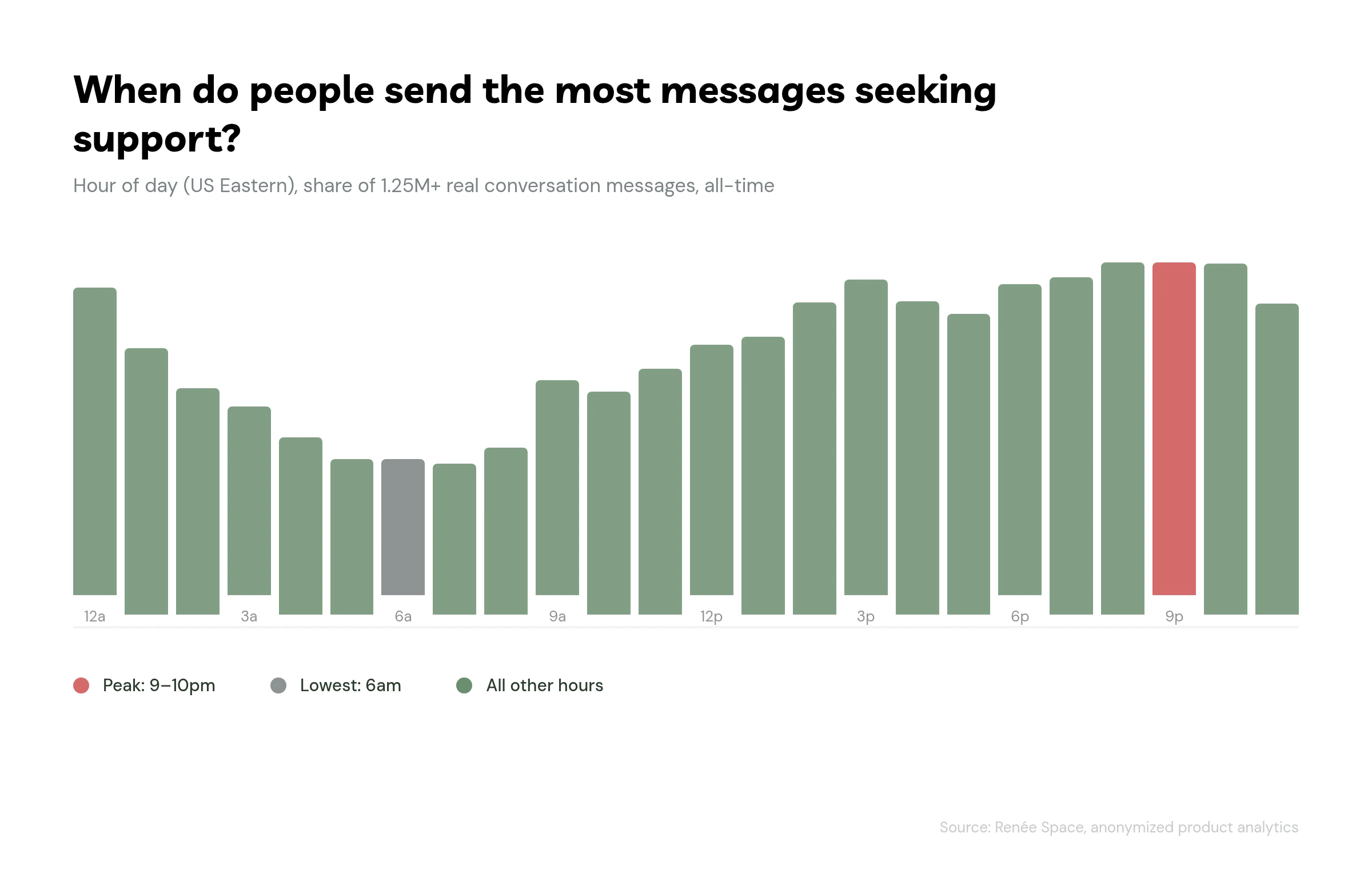
When do people send the most messages seeking support?
Fewer people reach out overnight, but they stay longer
If the 3am story were literally true, the overnight hours should be the busiest. They're close to the opposite. The 9pm hour has about 2.5 times as many conversations starting as the 4am hour does. Most people are asleep, which isn't surprising.
Raw volume only tells you how many people showed up, not what happened once they did. Looking at session length instead of session count flips the result. Conversations starting between 1am and 5am run about 14% longer on average than ones starting in the 7am-to-6pm daytime window — 15.7 messages per session versus 13.7. The single longest hour is 4am, averaging 16.5 messages per session, roughly 20% more than the 9pm peak.
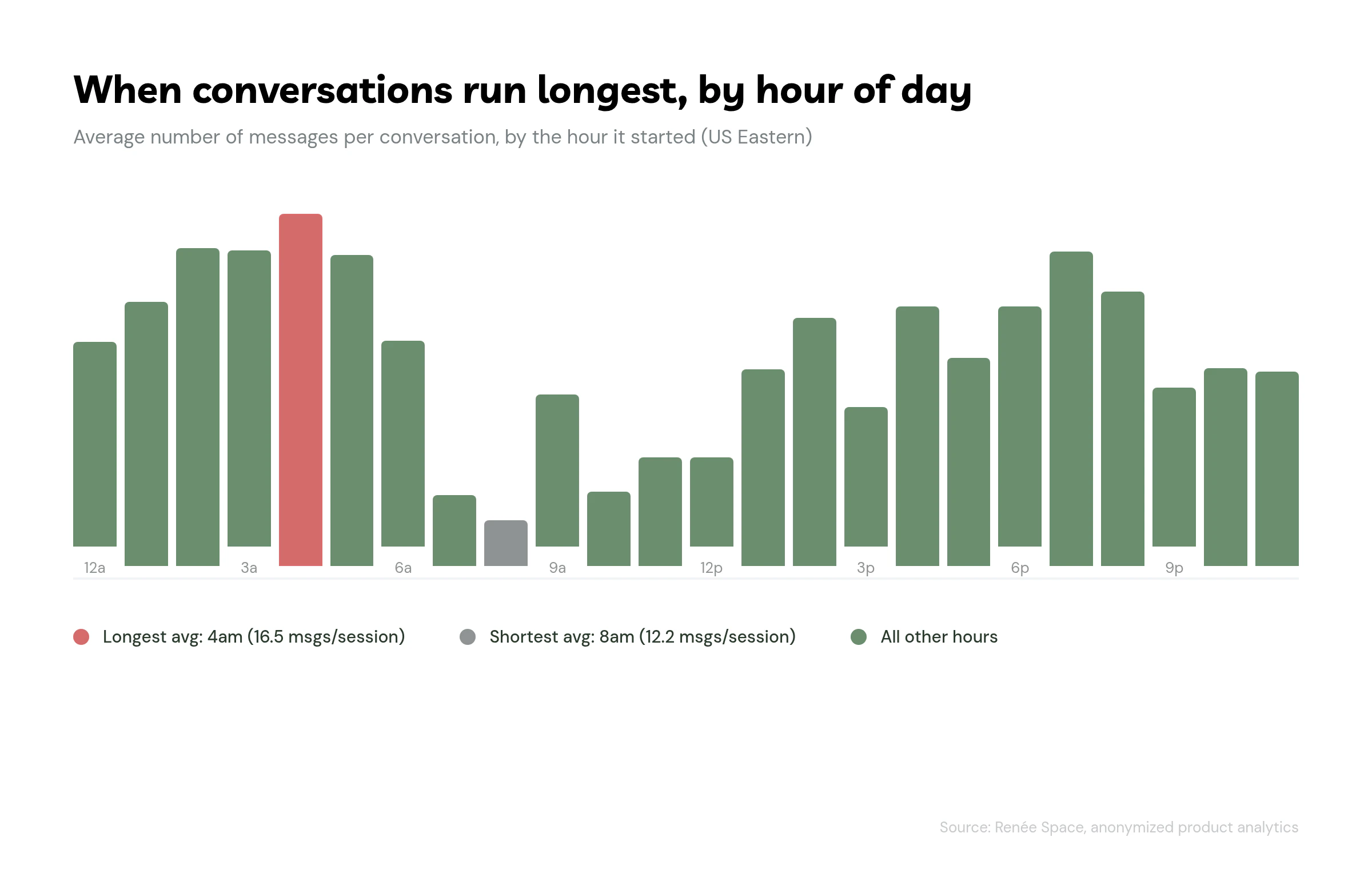
When conversations run longest, by hour of day
Message count is an imperfect stand-in for depth. A longer conversation can mean someone working through something difficult, or just someone with nowhere else to be at that hour. Either way, fewer people show up at 4am, and the ones who do tend to stay longer.
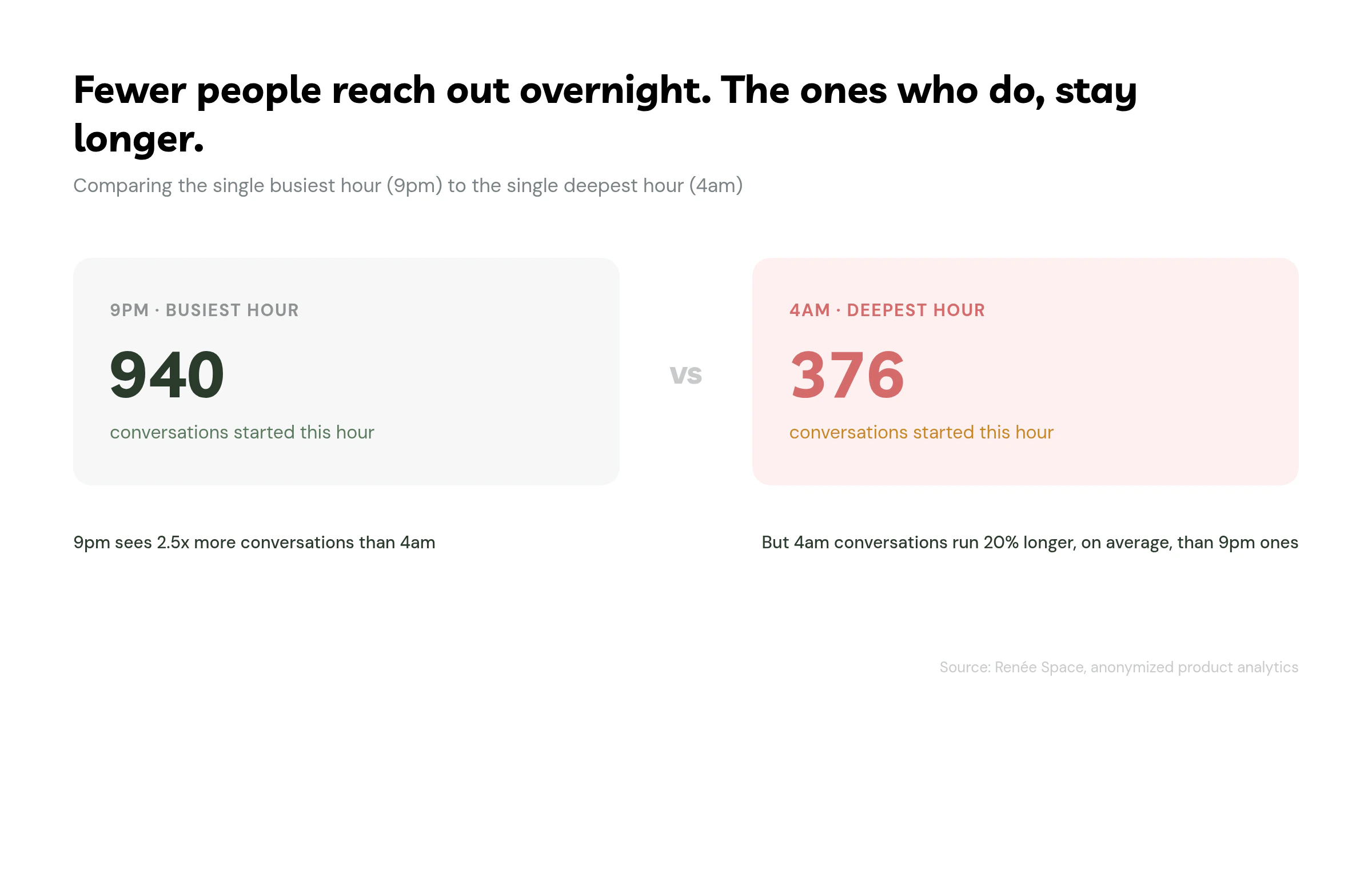
Fewer people reach out overnight. The ones who do, stay longer.
What sleep and loneliness research suggest
Let Renée help you

Advice
I feel stuck or unsure, and I could use some guidance to figure things out.

Talk it through
I find it hard to put my feelings into words, but talking will help me feel lighter.

Vent
Life feels overwhelming, I just need to let it all out (No unsolicited advice).

Fresh Perspective
I need someone to help me see things from a different, unbiased angle.
Two areas of research help explain why. The first is sleep. In a UC Berkeley study published in Current Biology01783-6), a single night of sleep deprivation produced about 60% more amygdala activity, the brain region tied to emotional reaction, when subjects viewed negative images. Someone awake at 4am has usually been awake for a while, and a sleep-deprived brain seems to regulate difficult emotions less effectively than a rested one.
The second is loneliness itself. Stephanie Cacioppo's research has found that lonely people show heightened, largely automatic alertness to signs that other people are unavailable or unfriendly. At 4am, with almost everyone else asleep, there's little around to contradict that. Neither study was run on this data, so this is an explanation that fits rather than one the data proves. But the pieces line up: less sleep, less company, and a harder time calming down.
Mornings look almost like the reverse
The data's other extreme sits a few hours later. The shallowest conversations of the day happen at 8am, averaging 12.2 messages per session, not far off from 6am's standing as the quietest hour overall. People are commuting, getting kids out the door, opening email. Some of that is logistics.
Some is probably biology. A 2022 Frontiers in Neuroscience review of the cortisol awakening response describes a sharp rise in cortisol shortly after waking, tapering off through the day. That surge is associated with mobilizing energy and attention for the day ahead, and it may be part of why a 4am worry can look smaller by 8am, even before anything about the situation has actually changed.
A smaller, heavier group
What's been weighing on you today?


Loneliness doesn't get worse at night in any simple sense. It gets rarer after midnight, and for the people still affected, it tends to get heavier. Most people who reach out do it in the early evening, before the day has fully emptied out. A much smaller group is still awake between 1 and 5am, and in this data, that's also when the longest, most involved conversations happen.
Methodology
This analysis draws on an anonymized dataset of real conversations about emotional support: over 1.25 million total messages, all-time through November 2026. Hour-of-day volume is based on user-sent messages only. Conversation "depth" (average messages per session) is based on nearly 16,000 sessions grouped by the hour each one started. About 94% of activity came from US-based users; timestamps were converted to US Eastern time as a representative approximation, so patterns for users in other time zones may be shifted slightly. "Overnight" refers to sessions starting between 1am and 5am; "daytime" refers to sessions starting between 7am and 6pm. These are correlations in usage patterns, not clinical measures of loneliness or distress.