
General
5 Best AI Mental Health Apps in 2026

Mental health support has never been more accessible. A growing category of AI-powered applications now offers structured emotional support, guided reflection, and evidence-based coping tools, available at any hour, without a waitlist.
| App | Key Features | User Experience | Pricing | Benefits | USP |
|---|---|---|---|---|---|
| Wysa | CBT exercises, mood tracking | Engaging chatbot | Freemium ($9.99/mo) | Evidence-based stress reduction | Mindfulness & emergency support |
| Abby.gg | Gamified AI companion | Fun, immersive | $4.99/mo | Emotional bonding & habits | Gaming elements for engagement |
| Talktoash | Voice chats, tone analysis | Intimate verbal | Freemium ($7.99/mo) | Empathy-driven processing | Advanced voice therapist focus |
| Earkick | Biofeedback, mood alerts | Data-driven | Free | Proactive anxiety prevention | Physiological data integration |
But not all applications are designed with the same purpose, rigor, or depth. This guide compares seven leading AI mental health applications across the dimensions that matter most: therapeutic approach, personalization, privacy, and long-term value. The goal is to help you make an informed decision based on your needs beyond marketing claims.
What to Look for in an AI Mental Health App
Before comparing specific applications, it is worth understanding the features that distinguish genuinely useful tools from those that offer only surface-level comfort:
- Evidence-based framework: Does the app apply recognized therapeutic methods , such as Cognitive Behavioral Therapy (CBT), Dialectical Behavior Therapy (DBT), or Acceptance and Commitment Therapy (ACT)?
- Longitudinal memory: Can the app learn from your history over time, rather than treating every session as a fresh start?
- Psychological depth: Does the app help you understand your patterns. not just manage symptoms in the moment?
- Check-ins: Does the app proactively reach out to track your mood and wellbeing between conversations, or does it only respond when you initiate?
- Privacy and data practices: Is your conversation data encrypted? Is it used to train commercial AI models?
- Safety protocols: Does the app detect crisis situations and connect users with appropriate resources?
With those criteria in mind, here is how the leading options compare.
Renée Space
Best for: People seeking meaningful psychological self-therapy & reflection alongside daily emotional support
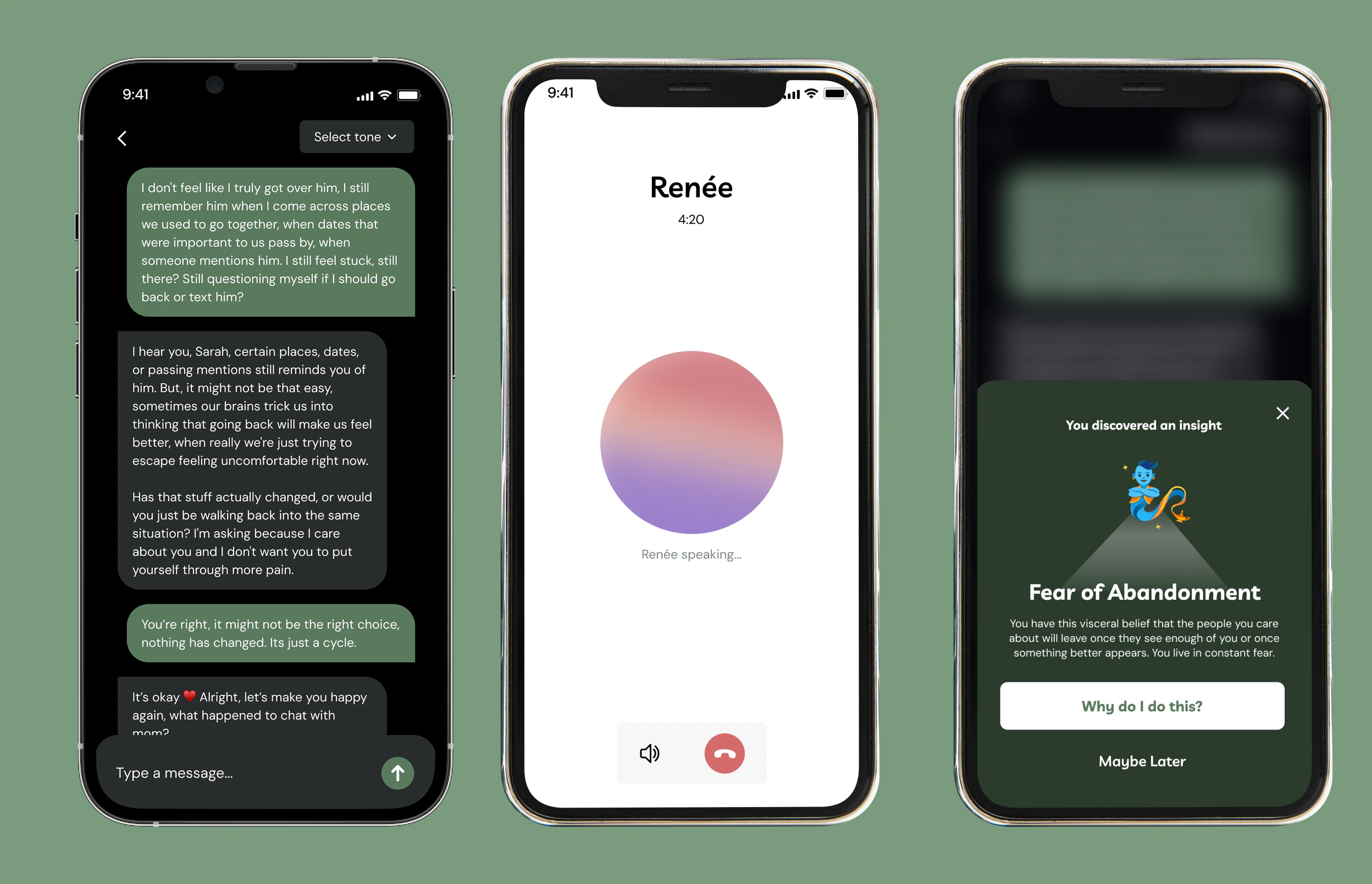
Renée is an AI-powered mental wellness companion designed around a simple but powerful premise: that lasting emotional well-being comes not from symptom relief alone, but from understanding the psychological patterns that shape how you think, feel, and relate.
Where most AI therapy apps focus on what you are feeling in a given moment, Renée is built to help you understand why, and to track how those patterns evolve over time. Its Insight Engine draws on a clinically grounded framework of psychological patterns, helping users recognize recurring dynamics such as people-pleasing, perfectionism, or avoidant attachment, and connect those patterns to their day-to-day experiences.
Therapeutic approach: Integrates CBT, ACT, and positive psychology with a proprietary pattern-recognition layer.
Pricing: Free tier available; subscription plans starting with monthly and annual options.
Platforms: Web.
Key Features
- Insight Engine — a clinically grounded psychological patterns framework (people-pleasing, perfectionism, avoidant attachment, and more) that identifies what is driving your emotional experience, beyond just what you are feeling in the moment
- Voice mode — speak naturally with Renée; no typing required, making support accessible in any moment, including when distress makes writing difficult
- Daily check-ins — Renée proactively reaches out to track your mood and emotional state between conversations, creating a consistent rhythm of self-awareness rather than reactive-only support
- Session notes and growth timeline — after each conversation, Renée reflects back what you explored and how your growth areas are developing; your progress is documented, not forgotten
- Persistent memory — Renée remembers what you have shared across every session, building a nuanced picture of you over time
Strengths
- Deep psychological self-understanding — built around a pattern frameworks that goes well beyond symptom tracking, helping users identify recurring emotional and relational patterns with clinical nuance
- Both voice and text — unlike many apps that offer one or the other, Renée supports natural voice conversation and typed reflection equally, fitting into how you actually feel like communicating on any given day
- Proactive, not just reactive — daily check-ins mean Renée is part of your routine, not just a resource you remember to open during a hard moment
- Persistent memory across sessions — Renée remembers what you've shared, tracks how you evolve over time, and uses that history to offer increasingly personalized insight
- Multi-dimensional support — addresses not just anxiety and depression, but identity, relationships, self-worth, purpose, and behavior patterns
- Session notes and growth timeline — after each conversation, Renée reflects back what you explored and how your growth areas are developing; your progress is documented, not forgotten
- Privacy-first design — your data is not sold or used to train third-party commercial models
Things to Consider
- Newer to the market than established players like Wysa or Woebot, with a growing but still-developing evidence base
- Most suited to users who are ready for self-reflection, not just symptom management, those seeking purely quick-relief tools may want to pair it with other resources
Wysa
Best for: Structured CBT exercises with access to human coaching
Wysa is one of the most clinically studied AI mental health apps available, with over 45 peer-reviewed studies and FDA Breakthrough Device Designation. It uses a friendly penguin avatar to guide users through a large library of structured exercises drawn from CBT, DBT, and mindfulness.
Therapeutic approach: CBT and DBT with 150+ structured exercises; optional human coach add-on.
Pricing: Free plan available; premium approximately $19.99/month or $74.99/year.
Platforms: iOS and Android.
Key Features
- 150+ evidence-based CBT and DBT exercises covering anxiety, sleep, stress, and mood
- Anonymous entry — no personal information or account required to begin
- Optional access to a human coach for users who want professional oversight
- Mood tracking and guided journaling
- Crisis detection and escalation to emergency resources
Strengths
- Strong clinical evidence base — among the most rigorously studied apps in this category
- Large library of structured coping exercises accessible on the free plan
- Genuinely anonymous — requires no personal information to begin
- Optional escalation to human coaches for users who want professional oversight
- FDA recognition lends credibility for users navigating employer wellness programs or clinical referrals
Things to Consider
- Does not retain memory across sessions, meaning the app cannot track patterns or refer back to what you've previously shared
- Text-only — no voice conversation
- The exercise-library model, while comprehensive, can feel more like a self-help tool than a responsive companion
- Free version has a limited content library; deeper features are gated behind the premium plan
- May feel formulaic to users seeking more open-ended emotional exploration
Woebot
Best for: Free, accessible CBT support with the strongest research foundation in the category
Woebot was developed by Stanford psychologists and remains one of the most evidence-backed AI mental health tools available — and it is entirely free. Its chatbot-style interface delivers CBT techniques through brief, structured daily check-ins.
Therapeutic approach: CBT, with elements of DBT and Interpersonal Therapy (IPT).
Pricing: Free.
Platforms: iOS and Android.
Key Features
- Daily mood check-ins with thought tracking
- CBT-based conversational exercises for depression, anxiety, and stress
- Structured psychoeducation modules (sleep, grief, substance use, and more)
- Fully free — no premium tier, no paywall
Strengths
- Completely free with no premium paywall — one of the few fully accessible options in this space
- Backed by 14 randomized controlled trials — the strongest clinical evidence base among AI therapy apps
- Developed with direct oversight from licensed psychologists
- Low barrier to entry; no personal information required
Things to Consider
- It isn’t available now for Direct to Consumer
- Relatively limited personalization — the experience is similar for most users and does not adapt meaningfully over time
- No session memory or longitudinal pattern tracking
- Text-only interface; no voice mode
- Daily check-ins can feel repetitive for long-term users
- Scope is primarily limited to mild-to-moderate depression and anxiety; not designed for broader psychological self-exploration
Ash
Best for: Voice-first emotional conversation with continuity across sessions
Ash is designed as an always-on emotional companion that emphasizes natural, flowing conversation over structured exercises. Its voice-first approach and session memory make interactions feel more like speaking with someone who knows you than navigating a self-help module.
Therapeutic approach: Therapy-inspired conversation; not a structured CBT/DBT program.
Pricing: Free tier available; premium plan required for full memory and voice features.
Platforms: iOS and Android (note: currently unavailable in Illinois due to state AI therapy legislation).
Key Features
- Voice-first conversational interface
- Session memory and cross-conversation continuity
- Weekly pattern insights summarizing recurring emotional themes
- Text conversation available alongside voice
Strengths
- Voice-first design enables more natural emotional expression — particularly useful for users who find typing a barrier
- Retains memory across sessions and can reference prior conversations to surface patterns over time
- Weekly pattern insights help users see recurring themes in their emotional experience
- Lower-pressure experience than structured exercise-based apps
Things to Consider
- Not designed as a clinical tool — lacks structured therapeutic frameworks (CBT, DBT, ACT)
- No dedicated meditation or guided relaxation features
- Uses anonymized conversation data to improve its models (opt-in, but worth noting)
- Currently unavailable in Illinois; regulatory landscape for AI therapy apps is actively evolving
- Companion framing can raise appropriate questions about emotional dependency for some users
Noah AI
Best for: Immediate voice support and real-time crisis grounding
Noah AI differentiates itself through its instant voice call feature — allowing users to connect with an AI therapist in seconds, including during moments of acute distress. It is designed for people who need access to support immediately, not after navigating a menu.
Therapeutic approach: CBT, ACT, and mindfulness; developed with licensed psychologist involvement.
Pricing: Approximately $10–15/month or $40–50/year after free trial.
Platforms: iOS and Android.
Key Features
- One-tap instant voice call for immediate support
- Session memory with cross-conversation continuity
- Therapy summary export — shareable reports for use with a human therapist
- Guided breathing and grounding exercises for crisis moments
Strengths
- One-tap voice call feature provides immediate support — particularly valuable during anxiety spikes or moments of overwhelm
- Session memory enables continuity across conversations
- Therapy summary export feature allows users to share session context with a human therapist, bridging AI and traditional care
- Developed with licensed psychologist involvement; strong safety protocols
Things to Consider
- Voice-only design means typed reflection and journaling are not core to the experience
- Newer and less independently studied than Wysa or Woebot
- Premium pricing is mid-range but adds up over time without clear evidence of outcome differentiation
- Voice interaction in public or shared spaces may be impractical for many users
Headspace Ebb
Best for: People who already use Headspace and want AI-guided reflection alongside a meditation library
Ebb is Headspace's AI companion, launched in late 2024 and rapidly expanded through 2025. It is deliberately positioned as a companion for self-reflection — not a therapist — and is most valuable as an extension of Headspace's existing meditation ecosystem.
Therapeutic approach: Reflective conversation with mindfulness integration; not a structured clinical program.
Pricing: Included with Headspace subscription (approximately $12.99/month or $69.99/year).
Platforms: iOS and Android.
Key Features
- AI companion (Ebb) integrated into the full Headspace ecosystem
- Voice mode and session memory (added late 2025)
- Access to 5,000+ guided meditations, sleep tools, and breathing exercises
- AI-powered care triage to route users to appropriate resources
- Multi-layered crisis monitoring
Strengths
- Seamlessly integrated with 5,000+ guided meditations, sleep tools, and mindfulness content
- Voice mode and session memory added in late 2025
- AI-powered care triage helps route users to appropriate resources
- Trusted, established brand with strong credibility in the wellness space
- Multi-layered crisis monitoring system
Things to Consider
- Primarily a wellness companion, not a therapeutic tool — lacks clinical frameworks like CBT or DBT
- Value is most apparent for existing Headspace subscribers; standalone cost is high if you are not already using the meditation library
- AI companion experience is newer and less refined than dedicated therapy-focused apps
- Conversation depth and psychological insight are more limited compared to apps built specifically for mental health
Flourish
Best for: Proactive wellness and evidence-based habit building
Flourish is grounded in positive psychology and behavioral science, and has been tested in two large randomized controlled trials. Unlike most AI therapy apps that respond to distress, Flourish is built for people who want to proactively strengthen their emotional health through daily habits, community, and gamified progress.
Therapeutic approach: Positive psychology, behavioral science, and affective science.
Pricing: Subscription-based; free trial available.
Platforms: iOS and Android.
Key Features
- Gamified daily habit tracking and mood logging
- Peer community and social accountability features
- AI-curated coping tools and resilience-building exercises
- Progress visualization and streak tracking
- Clinically tested in two large randomized controlled trials
Strengths
- Two large RCTs validate effectiveness — rare in this category
- Gamified design and community features support habit formation and long-term engagement
- Broad well-being focus: resilience, stress, mood, relationships — not just symptom management
- Frequently recommended by therapists and coaches as a between-session tool
- Joyful, motivating user experience
Things to Consider
- Better suited to proactive wellness than acute emotional distress — not designed for users in crisis or managing significant symptoms
- Less focused on deep psychological self-exploration or pattern recognition
- Community features mean aspects of the experience are social rather than private
- Gamification approach may feel incongruent during periods of genuine emotional difficulty
| Feature | Renée | Wysa | Woebot | Ash | Noah AI | Ebb | Flourish |
|---|---|---|---|---|---|---|---|
| Session memory | ✓ | ✗ | ✗ | ✓ | ✓ | ✓ | Partial |
| Voice mode | ✓ | ✗ | ✗ | ✓ | ✓ | ✓ | ✗ |
| Daily check-ins | ✓ | Partial | ✓ | ✗ | ✗ | ✗ | ✓ |
| Pattern recognition | ✓ Deep (98 patterns) | Basic | Basic | Partial | Partial | ✗ | Partial |
| Session notes / growth log | ✓ | ✗ | ✗ | Partial | Partial | ✗ | ✗ |
| Clinical framework | CBT/ACT/98-pattern | CBT/DBT | CBT/DBT/IPT | Therapy-inspired | CBT/ACT | Mindfulness | Positive psych |
| Clinical evidence | Growing | Strong | Strongest | Limited | Limited | Limited | Strong (2 RCTs) |
| Free tier | ✓ | ✓ | ✓ (fully free) | ✓ | Trial only | With subscription | Trial only |
| Privacy-first | ✓ | ✓ | ✓ | Opt-in data use | ✓ | ✓ | ✓ |
| Best for | Self-understanding | Structured exercises | Free CBT | Voice conversation | Meditation + reflection | Habit building |


