
Comparison
Renée vs. Abby: The Best AI Therapist

More people than ever are turning to AI for emotional support. The appeal is clear: available at any hour, no waitlists, no stigma. But as demand has grown, so has the range of tools claiming to help, from general-purpose chatbots to apps purpose-built for mental health.
The distinction matters. General-purpose AI models are not designed with clinical safeguards in mind. A CharacterAI chatbot has been linked to a teenager's death. OpenAI has acknowledged that ChatGPT contributed to worsened delusional thinking in a vulnerable user. The American Psychological Association has called on the Federal Trade Commission to regulate mental health chatbots that operate without clinical grounding or ethical oversight.
Purpose-built platforms approach this differently. They are designed with specific populations in mind, informed by clinical frameworks, and built to operate within defined limits. Renée is one such platform,an AI mental wellness companion grounded in psychological pattern recognition, designed to support emotional self-awareness over time.
This article compares Renée with Abby (abby.gg) across six areas: therapeutic approach, session memory, features, safety and privacy, pricing, and who each platform is best suited for.
Overview
Renée is an AI mental wellness companion designed for adults seeking structured, ongoing emotional support. It is built around psychological pattern recognition and longitudinal session memory. The platform is intended for users who want insight into recurring emotional and behavioral patterns, not only immediate relief from acute distress.
Abby is a free AI therapy assistant developed by Abby Intelligence, Inc. It is designed for broad accessibility, offering support in over 26 languages with no cost to the user. Abby is intended for individuals seeking on-demand emotional check-ins and general guidance.
Therapeutic Approaches
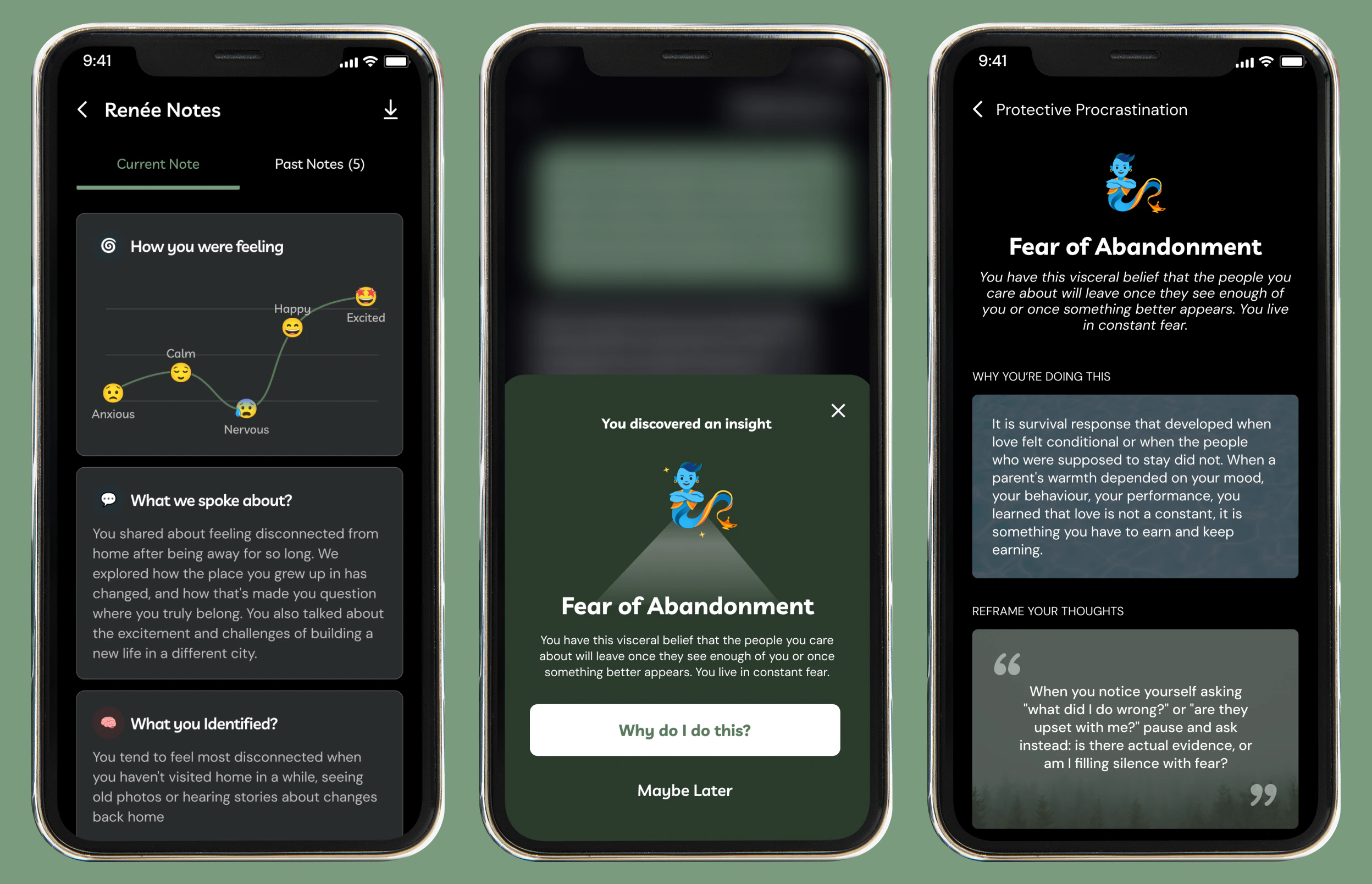
Renée
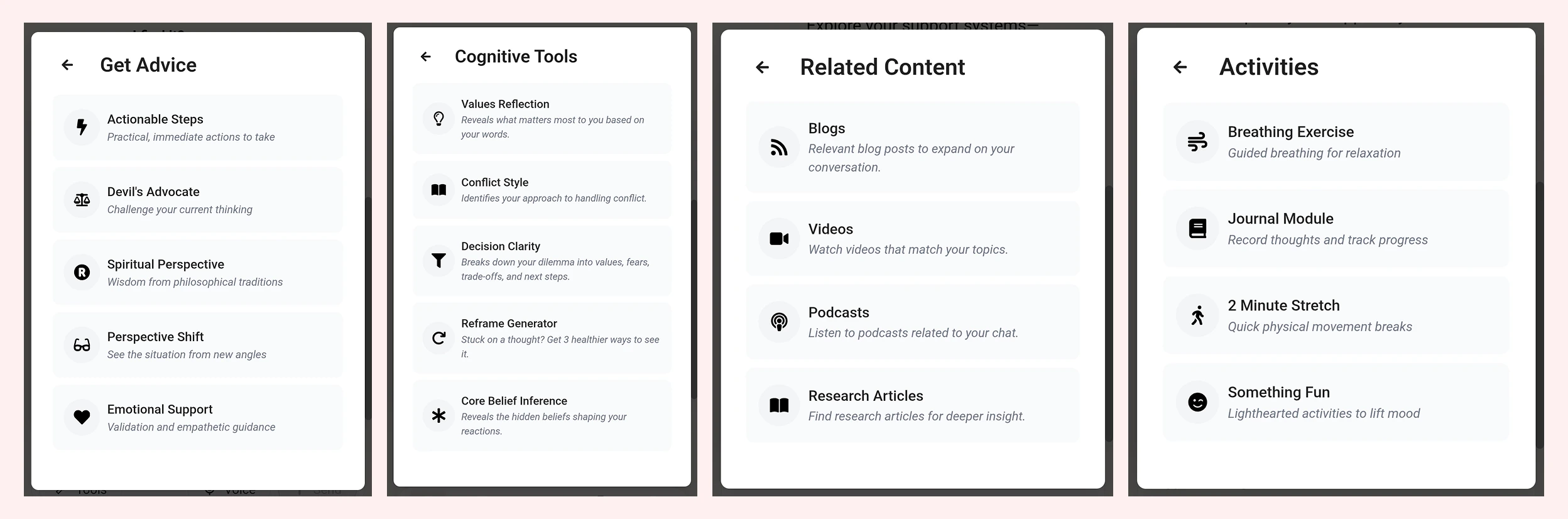
Abby
Therapeutic Frameworks
Renée
Renée applies established clinical frameworks including Cognitive Behavioral Therapy (CBT), Acceptance and Commitment Therapy (ACT), and Internal Family Systems (IFS). These frameworks are applied based on the context of a user's conversation history, not administered as fixed modules.
The platform's primary clinical mechanism is psychological pattern recognition, a structured process of identifying recurring emotional, cognitive, and behavioral patterns across sessions. Patterns such as avoidance, rumination, perfectionism, and attachment anxiety are surfaced and reflected back to the user over time.
Responses are calibrated to the user's expressed state in each session and to patterns identified across prior sessions. The conversational structure is designed to support self-awareness alongside immediate emotional relief.
Abby
Abby draws from a broad range of therapeutic modalities, including CBT, Dialectical Behavior Therapy (DBT), Gestalt Therapy, Psychodynamic Therapy, and Adlerian Therapy. These are referenced in the platform's support documentation.
Abby's responses are primarily reactive, generated in response to what the user shares within a given session. The platform is designed for accessibility rather than clinical depth. It is well suited for users who want general emotional guidance without a structured therapeutic framework.
What this means: Renée is structured around identifying patterns across time. Abby is structured around responding to immediate input. Users with ongoing emotional concerns may find different levels of clinical utility in each.
Session Memory
Renée
Renée retains information across sessions. User history, identified patterns, and prior conversation themes are carried forward into each new session. A returning user is not required to re-establish context. The platform uses accumulated session data to refine its pattern assessments over time.
This cross-session memory is the foundation of Renée's Pattern Recognition Engine, clinically-sourced psychological patterns. In user validation testing, pattern accuracy was rated at 92.5%.
Abby
Abby provides continuity within individual sessions and retains a degree of personalization across interactions. Cross-session pattern synthesis is not a stated core feature of the platform.
For users who access the platform occasionally and for discrete emotional concerns, this is unlikely to affect the utility of the tool. For users engaged in longer-term emotional work, the absence of deep longitudinal memory may limit the depth of insight available.
What this means: Users seeking to track emotional patterns or work on recurring concerns over time will find more structured support in Renée's memory architecture.
Core Features
Renée
In addition to conversational support, Renée offers the following features:
- Pattern Recognition Engine: Identifies psychological patterns across a user's session history using 98 clinically-sourced pattern categories. User-validated accuracy: 92.5%.
- Session Notes: A structured summary of key themes and insights is generated at the close of each session and made available for the user's review.
- Personalized Check-ins: Structured check-ins are available to support consistent emotional self-care practices.
- Voice Call: Ability to have live voice conversation when texting feels too overhwelming
Abby
Abby offers the following features beyond text-based chat:
- Multilingual Support: Available in 26+ languages.
- Enterprise Modules: Vertical-specific offerings have been developed for corporate employees, educational institutions, healthcare workers, military personnel, and law enforcement.
What this means for users: Renée's features are oriented toward insight and self-reflection over time. Abby's features are oriented toward broad access and daily availability. Users with specific language needs or enterprise access may find Abby's feature set more relevant to their circumstances.
Who is it for?
Renée may be appropriate for individuals who:
- Are working on recurring emotional patterns such as anxiety, relationship difficulties, low self-worth, or burnout
- Prefer a platform that retains session history and refines its support over time
- Want structured summaries and reflective tools in addition to conversational support
- Are willing to pay for a subscription-based product with layered features
Abby may be appropriate for individuals who:
- Are seeking low-cost or no-cost emotional support
- Prefer occasional, on-demand check-ins rather than ongoing structured engagement
- Communicate primarily in a language other than English
- Have access to Abby through an employer, school, or institutional plan
| Category | Renée | Abby |
|---|---|---|
| Therapeutic Framework | CBT, ACT, IFS; pattern recognition; longitudinal | Multi-modality; reactive; session-based |
| Session Memory | Cross-session; persistent pattern tracking | Within-session; limited longitudinal synthesis |
| Notable Features | Pattern Recognition Engine, Session Notes, Journal Prompts | Daily check-ins, voice chat, multilingual (26+ languages) |
| Pricing | Subscription; free trial | Free tier; paid from ~$20/mo |
| Best For | Long-term pattern-based emotional work | Immediate, low-cost, accessible support |
Why Renée Is Recommended for Most Users
For users who are looking for more than a place to vent, Renée is the more clinically considered choice.
Most AI mental health apps, including Abby, are designed around availability. They respond to what a user brings to a session and provide support in that moment. That has value. But availability alone does not produce insight, and insight is what drives meaningful, lasting change in emotional wellbeing.
Renée is designed around a different premise: that understanding why you feel the way you do, repeatedly, across situations, is more useful than managing how you feel in the moment. Its Pattern Recognition Engine does what no on-demand chatbot can: it identifies the structural patterns underneath a user's emotional experience and makes them visible. Patterns like chronic avoidance, people-pleasing, emotional suppression, or anxious attachment do not resolve through a single conversation. They resolve through recognition, repetition, and reframing over time. Renée is built for that process.
Several specific factors distinguish Renée for users engaged in ongoing emotional work:
Clinical depth. Renée applies CBT, ACT, and IFS frameworks contextually across sessions, not as static modules, but as tools calibrated to where a user actually is in their process.
Longitudinal memory. Renée retains and builds on prior sessions. It does not treat each conversation as isolated. For users working through recurring concerns, this continuity is clinically meaningful.
Session Notes. At the close of each session, Renée generates a structured summary of themes and insights. This supports reflection between sessions and mirrors a practice common in clinical therapy.
Transparent positioning. Renée is clear about what it is and what it is not. It does not market itself as a therapist replacement or an always-free service. That transparency is itself an indicator of how seriously the platform takes its responsibility to users.
For users whose primary need is, multilingual, on-demand support, Abby remains a reasonable option. But for users who want a platform that compounds in value the longer they use it, one that gets to know them, identifies what is holding them back, and supports genuine self-understanding, Renée is the more effective tool.
Let Renée help you

Advice
I feel stuck or unsure, and I could use some guidance to figure things out.

Talk it through
I find it hard to put my feelings into words, but talking will help me feel lighter.

Vent
Life feels overwhelming, I just need to let it all out (No unsolicited advice).

Fresh Perspective
I need someone to help me see things from a different, unbiased angle.


